Let's connect!
Thank you! Your submission has been received!
Oops! Something went wrong while submitting the form.
April was an exciting release month at Lula, with new capabilities landing across merchandising, pricing, payments, and integrations. Two themes tie the work together: giving retailers more deliberate control over how their products show up online, and removing the manual stitching that has historically sat between systems.
Here's a recap of what's new:
The April release added a set of tools that give retailers more control over how products show up online and clearer visibility into what's actually working.
Secondary Brands lets retailers operate multiple digital storefronts across marketplaces from a single store location and a single tablet. A convenience store can run a restaurant-style storefront for prepared foods alongside a retail storefront for CPG products, each tuned to its category and more discoverable to the shoppers searching for it. Inventory and order processing stay unified, so multi-brand presentation doesn't mean multi-brand complexity.
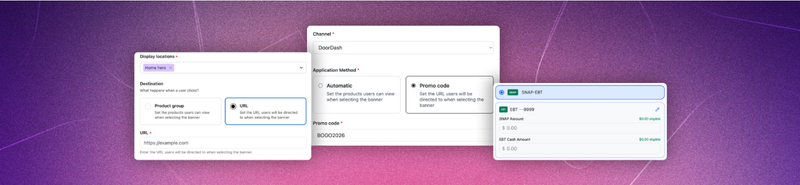
Banner Enhancements transform Lula Direct banners from static images into measurable campaign objects. Banners now live under the Campaigns tab with deterministic targeting, scheduling, click interactivity, and session-based revenue attribution. Link a banner directly to a category or specific UPC, schedule start and end dates, and watch impressions, CTR, and conversion roll up by campaign.
Featured Product Sections give merchants drag-and-drop control over storefront merchandising, with time-windowed activation so a "Lunch Special" section runs only 11 am–2 pm. Inventory filtering and per-channel scoping happen automatically.
Granular Upcharging addresses one of the most operationally painful problems in digital convenience retail: pricing across channels. Merchants can now set specific upcharge percentages at both the item and category level, including different prices for delivery versus pickup. Those prices flow cleanly to DoorDash, Uber Eats, Grubhub, and Lula Direct with no manual reconciliation.
Product Enrichment combines third-party datasets with Lula's global catalog to deliver comprehensive nutritional information, allergen data, and detailed product specifications across every channel. The downstream effect is conversion, and shoppers who can answer their own product questions on the page don't bounce, with the added benefit of compliance in regulated markets like California.
Promo Authoring replaces the multi-system promotion headache. Build a promotion once and sync it automatically across DoorDash, Uber Eats, Grubhub, and Lula Direct. The system supports order discounts, item discounts, BOGO offers, and delivery incentives, with time-zone-aware scheduling, per-DSP deployment tracking, cohort segmentation, and real-time performance data. When a promotion takes minutes instead of an afternoon, retailers run more of them — and they run them better.
Order Routing with Fresh KDS automatically routes prepared food orders from Lula directly to retailer kitchens, eliminating manual receipt printing. Kitchen staff get clear digital instructions instantly, store managers gain visibility into prep capacity, and delivery drivers find ready orders when they arrive, cutting the wait time that drags down both customer experience and DSP performance metrics.
EBT/SNAP through Forage is one of the most consequential additions of the month. SNAP recipients represent a meaningful share of grocery and convenience spend in the US, and the inability to accept SNAP benefits online has historically locked many of those shoppers out of digital ordering entirely. The new integration enables eligible consumers to purchase qualifying items online with seamless payment splitting between SNAP benefits and other payment methods. Eligible items are clearly identified, balances are visible, and the experience is built around dignity and privacy. For retailers, this expands the addressable market overnight.
These features were built to work together. A Featured Section on Lula Direct can be paired with a banner driving traffic to it, an upcharge structure protecting margin on the items inside, enriched product data closing the sale, and a promo amplifying the offer across every channel a shopper might use. Meanwhile, the kitchen routes orders without staff intervention, marketplace accounts connect themselves, and payment options expand to a broader customer base.
The throughline is simple: the platform should take on more of the operational weight, so retailers can spend their time on growth and on running great stores.
Visit our Lula Commerce Release page to learn more.